

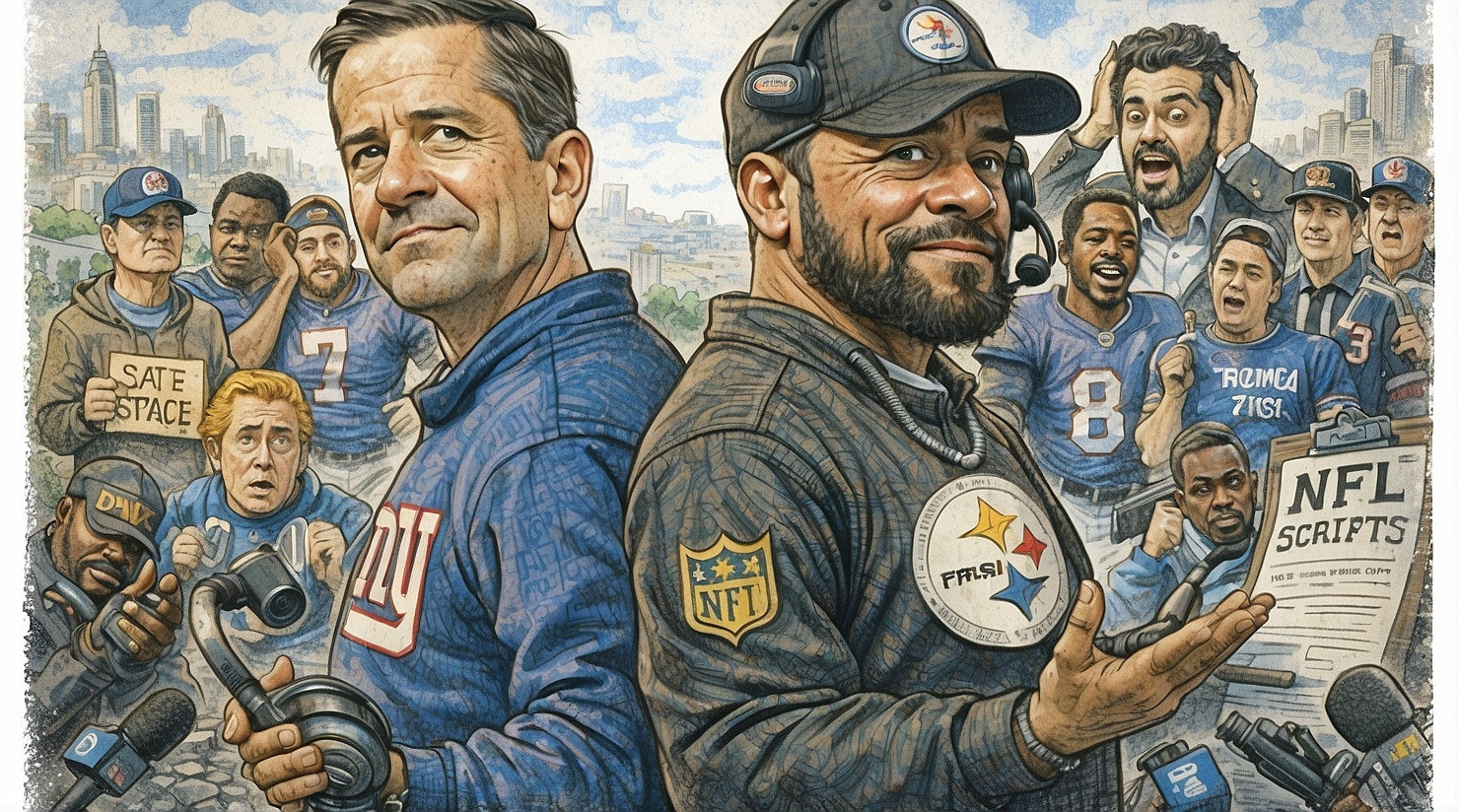
The NFL reportedly plunged into chaos this week after John Harbaugh was fired, Mike Tomlin retired unexpectedly, and left-wing commentators immediately assured fans this was all very normal and definitely not coordinated, sources have confirmed.
According to insiders, Harbaugh was quietly lined up for the New York Giants job before New York City Mayor Zohran Mamdani was seen publicly fretting that Harbaugh supports President Trump and questioning whether New York really wants “hard-hitting, emotionless football.”
“Is accountability inclusive?”
Mamdani allegedly asked, clutching a foam finger labeled Feelings First.
When Mike Tomlin heard the rant, he reportedly voiced support for his longtime rival before announcing his retirement, telling friends he was “tired of listening to people whine on Sundays” and wanted out before tackling was replaced with guided breathing exercises.
League officials insist the two departures are unrelated, despite leaked memos expressing concern that both coaches “don’t fit next season’s script.”
One executive allegedly explained, “They keep winning with discipline, and that’s confusing to the audience.”
Some sources claim Harbaugh and Tomlin are pulling a Freaky Friday–style switch, while others say Tomlin simply refused to coach players who require trigger warnings before blitz packages.
As of press time, the NFL accidentally reassured fans that the NFL will remain scripted to include emotional awareness and less aggressive tackles.



This is pro football they’re suppose to be aggressive. People who don’t like contact sports should watch golf. Leave football alone it’s a great sport for most of us. Two of the best coaches in the game are gone now because of this change in policy. We gonna play flag football in the fall. The Europeans won’t like this change either.
Love your sense of humor guys. Keep up the good work!
Love the satire. Even funnier when people rant over the seriousness.
FOR IMMEDIATE RELEASE
Congress Member IO Introduces a “No Tax on Protesters Act,” Asks Congress to Decide Which Work Actually Counts
Washington, D.C. — Congress Member IO today introduced the No Tax on Protesters Act, legislation challenging Congress to apply its tax principles consistently by recognizing organized protest as legitimate civic labor deserving of tax relief, deductions, and long-term benefits.
The proposal follows recent efforts to exempt select categories of income from federal taxation based on the nature of the work performed. IO’s bill extends that same logic to individuals who spend substantial time and resources engaging in organized protest—often full time, often at personal risk, and frequently without the economic protections afforded to other recognized occupations.
“Apparently, we’ve decided that some work is real work and some isn’t,” IO said. “This bill simply asks Congress to explain why standing for ten hours holding a sign doesn’t count as labor, but standing for ten hours holding a tray does.”
Under the No Tax on Protesters Act, income earned through protest-related activity—including stipends, organizational compensation, honoraria, or structured donations—would be exempt from federal income taxation. Protesters would also be permitted to deduct ordinary and necessary business expenses, including signs, sign sticks, protective face coverings, safety gear, transportation, communication equipment, bond money and other materials required to perform their work.
“Anyone who thinks protesting is free has never paid for poster board, printing, masks, gas, food, legal support, or bail,” IO added. “Those costs add up. The IRS notices everything else—this bill suggests it notice that too.”
The legislation further directs the Social Security Administration to establish standards under which sustained protest activity may qualify as covered employment for purposes of Social Security credits, Medicare eligibility, and other federal benefits. Eligibility would be based on measurable criteria such as frequency, duration, organizational structure, and documentation—standards already applied to freelancers, gig workers, and other nontraditional labor.
Reaction on Capitol Hill was swift.
Congress Member CB expressed concern but support
for the proposal, but warning of unintended consequences. “If we start calling protesting a job,” SH said, “we may have to admit that a lot of people have been working very hard for years without pay, benefits, or respect. That could set a troubling precedent.” quote to help all that there should be a denim that a protester after one year of protesting would be subject to Implant and Periodontal all that there should be a denim that a protester after one year of protesting would be subject to immediate citizenship.“ “That would solve all of our illegal alien problems, as well as further reduce the tax money that we get to spend each year” when an intern boy toy of Congressman CB realized what he has said about the tax money CB then assured that all of the new illegal alien Citizen’s were A new low income wage group that would generate some new income each year that they could tax and not hurt the money they have to spend on other programs like important studies of determining the wear and tear on protesters feet and providing the protesters, free vehicles that they could use for transportation and ramming to determine which vehicles are the safest in an auto accident.
Supporters of the bill argue that the reaction underscores its premise: that civic labor is praised rhetorically while excluded economically.
“For decades, protesters have been told they’re essential to democracy but optional to the economy,” IO said. “They age. They get injured. They retire. And they do so without the protections we extend to nearly everyone else who works.”
The No Tax on Protesters Act has been referred to the House Committee on Ways and Means. IO called for hearings not only on implementation, but on the broader question of how the nation defines work.
“Democracy keeps telling people to speak up,” IO concluded. “This bill asks whether we’re prepared to admit that speaking up has a cost—and whether we’re willing to treat that cost honestly.”